
FREE ACCELERATOR
ARIS Process Mining | Object-Centric Process Mining | OCPM | Client Onboarding | Banking | KYC | AML | ID&V | Operational Excellence
This dedicated Object-Centric Process Mining accelerator for ARIS Process Mining is purpose-built to optimize Client Onboarding in Banking across both Personal Banking and Business Banking. It connects multiple onboarding objects — such as clients, onboarding applications, documents, ID&V checks, screening alerts, risk profiles, KYC cases, and accounts — into one end-to-end process view, enabling banks to analyze onboarding as it actually runs across channels, teams, and systems
The accelerator provides ready-to-use insights into critical use cases such as wasted time, manual processing of ID&V, long onboarding times, overprocessing of cases, and AML conformance — helping banks increase straight-through processing, reduce onboarding delays, lower manual effort, strengthen compliance, and improve the client experience.
BOOK A DEMO
Talk to our experts and see how an Accounts Payable solution powered by ARIS Process Mining can unlock significant business value — from touchless invoicing and faster exception handling to better working capital management.
Dashboard Previews: See It in Action


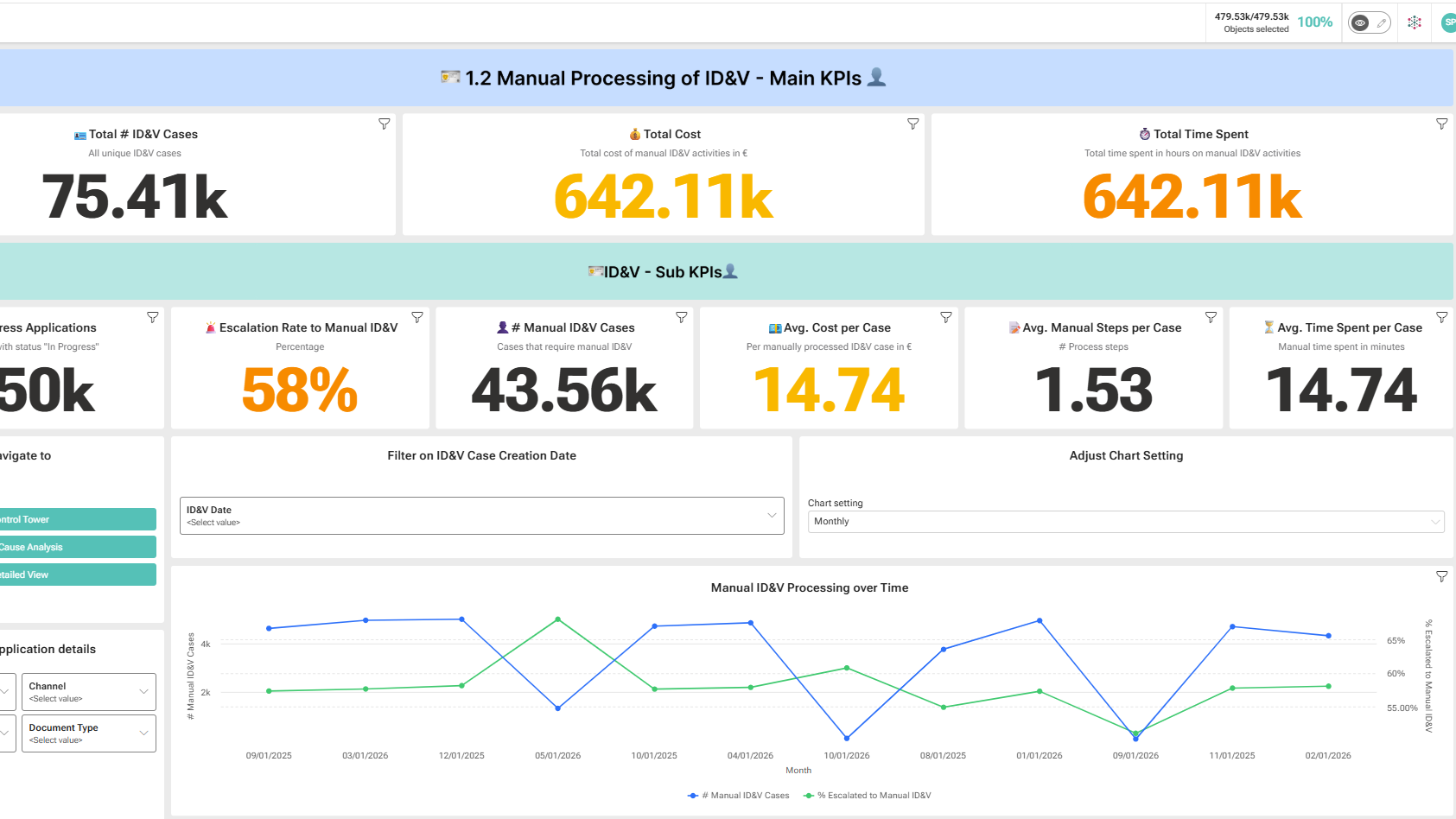


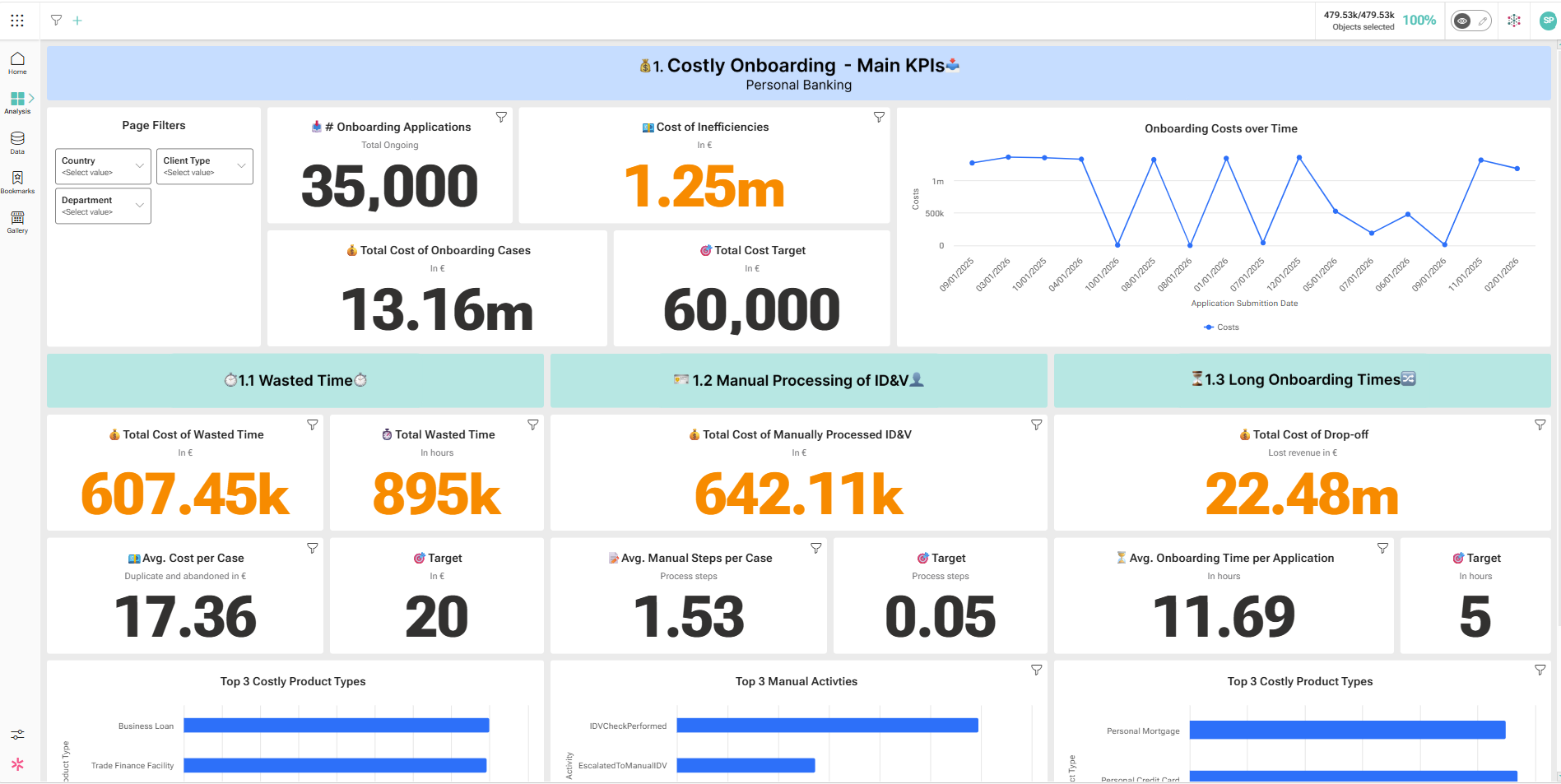


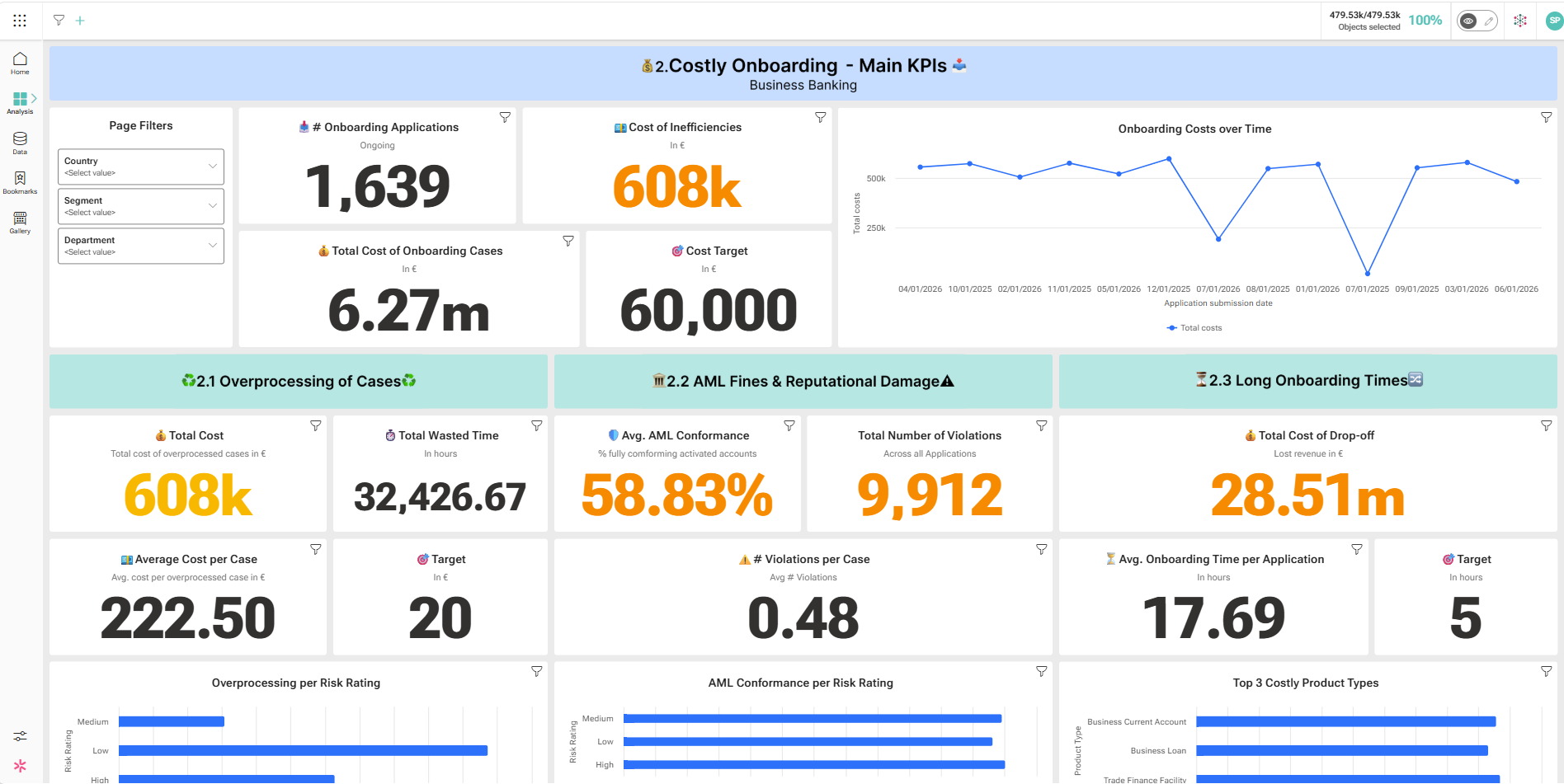
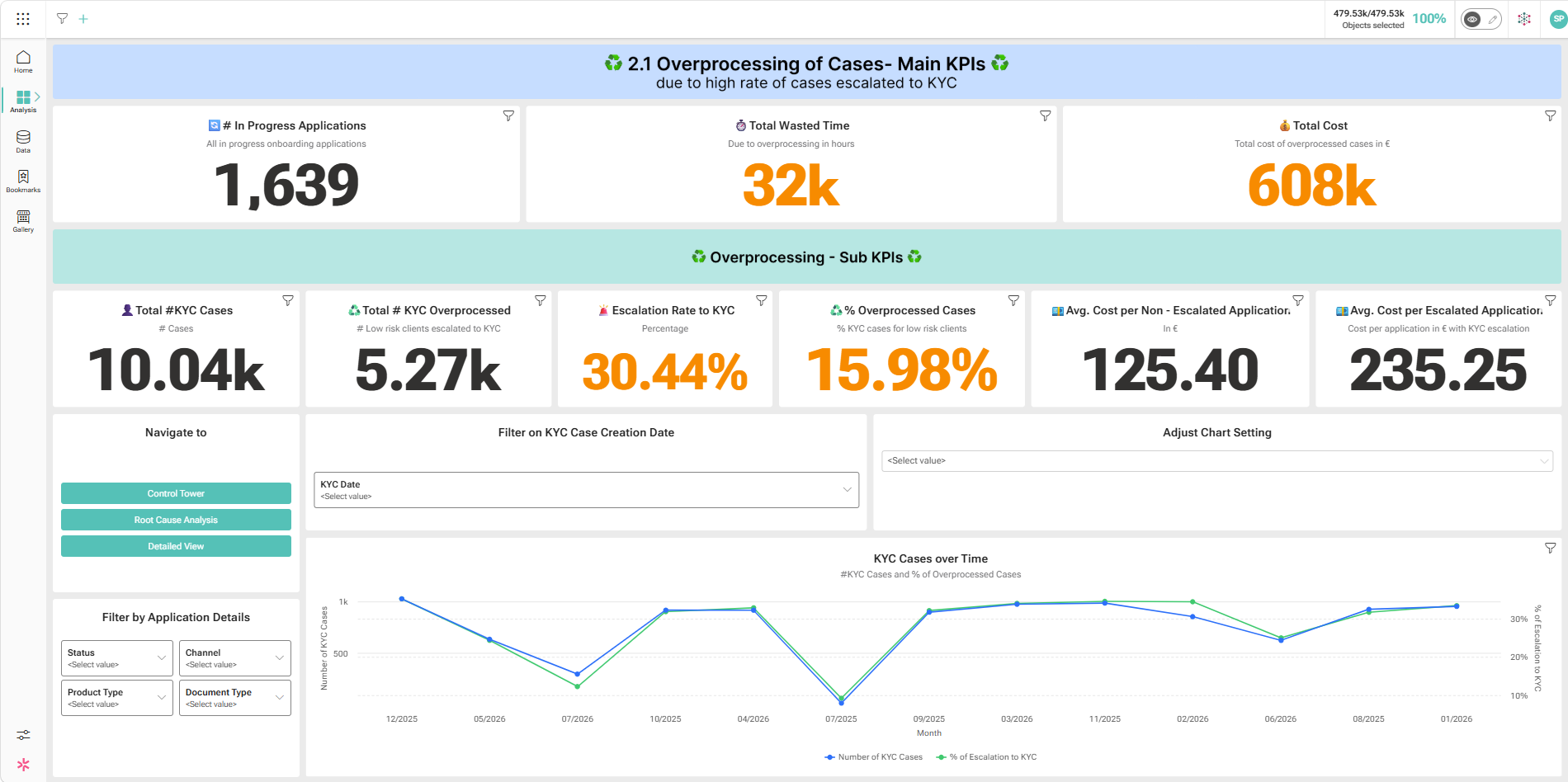


What Object-Centric Process Mining Solves for Your Client Onboarding
- WASTED TIME ON DUPLICATE AND ABANDONED APPLICATIONS
Identifies where applicants drop out, re-apply, or create duplicate cases across channels, helping teams reduce wasted effort and recover conversion opportunities. - MANUAL PROCESSING OF ID&V DRIVING COST AND DELAYS
Reveals where identity verification falls out of automation into manual review, helping banks improve straight-through processing and reduce applicant friction - LONG ONBOARDING TIMES HURTING CONVERSION AND TIME-TO-REVENUE
Exposes bottlenecks, rework loops, hand-off delays, and stalled cases that extend onboarding cycle times and increase the risk of client abandonment. - OVERPROCESSING OF LOW-RISK BUSINESS BANKING CASES
Detects where low-risk cases are unnecessarily escalated into full KYC or enhanced due diligence, helping banks reduce analyst workload and focus capacity on genuinely high-risk clients. - AML CONFORMANCE GAPS CREATING REGULATORY AND REPUTATIONAL RISK
Identifies skipped, delayed, or inconsistent KYC, screening, EDD, and approval steps, helping compliance teams demonstrate audit-ready conformance. - LACK OF END-TO-END VISIBILITY ACROSS APPLICATIONS, DOCUMENTS, CHECKS, AND ACCOUNTS
Connects clients, applications, documents, ID&V checks, screening alerts, risk profiles, KYC cases, and accounts into one object-centric view of the onboarding journey.
Improvement Areas in Client Onboarding — Ready USE CASES for Conversion, Compliance, and Operational Excellence
-
WASTED TIME
- Reduced wasted effort from duplicate, abandoned, and re-applied onboarding cases.
- Better visibility into where applicants drop out across web, mobile, branch, and assisted channels.
- Improved conversion by identifying recovery opportunities before prospects are lost.
-
MANUAL PROCESSING OF ID&V
- Higher straight-through identity verification by identifying where automated checks fail or become inconclusive.
- Reduced manual review workload caused by poor document quality, data mismatches, or unsupported document types.
- Shorter verification cycle times and improved applicant experience during a critical onboarding step.
-
LONG ONBOARDING TIMES — PERSONAL BANKING
- Faster onboarding by exposing rework, manual touchpoints, stalled cases, and hand-off delays.
- More predictable cycle times across high-volume onboarding journeys.
- Reduced abandonment by helping teams understand where applicants wait too long or lose visibility.
-
OVERPROCESSING OF CASES
- Reduced unnecessary KYC and EDD escalations for low-risk business banking clients.
- Better use of analyst capacity by focusing detailed reviews on genuinely high-risk cases.
- Shorter onboarding times and lower cost-to-onboard for standard or low-risk business clients.
-
AML CONFORMANCE
- Stronger compliance by detecting skipped, inconsistent, or delayed AML, KYC, screening, and approval steps.
- Improved audit readiness through transparent evidence of required checks and case execution.
- Reduced regulatory and reputational risk by identifying conformance gaps before they become findings.
-
LONG ONBOARDING TIMES — BUSINESS BANKING
- Reduced hand-off delays across front office, KYC, compliance, operations, and account setup.
- More predictable onboarding timelines for relationship managers and business clients.
- Improved time-to-revenue by helping clients reach account activation faster.
What This Accelerator Delivers
This plug-and-play accelerator provides everything you need to analyze and improve Client Onboarding(Banking)—preconfigured, actionable, and ready to use. It includes:
- Preconfigured transformation logic for the relevant OCPM data model
- Ready-to-use accounts payable KPIs
- Standard dashboards and analyses for key use cases
- Prepared to address typical accounts payable pain points
- Fast deployment on ARIS Process Mining
Client Onboarding Process: End-to-End Happy Path and Operational Variations
Client Onboarding is made up of several interconnected process steps covering application intake, data and document collection, identity verification, screening, risk profiling, approval, account setup, and account activation. While a standard happy path exists — from receiving an onboarding application through successful verification, approval, account setup, and activation — real-world onboarding is shaped by process variants and exceptions such as duplicate applications, missing or incorrect documents, failed ID&V checks, manual reviews, screening hits, enhanced due diligence, rejected applications, and wrong account setup.
With Object-Centric Process Mining, these variations can be analyzed across multiple connected objects — including clients, applications, documents, checks, alerts, risk profiles, KYC cases, and accounts — instead of forcing the process into a single case view. This helps banks understand how delays or issues in one object, such as a missing document or unresolved screening alert, affect the overall onboarding journey. The diagram below illustrates both perspectives.

Application Structure & Navigation
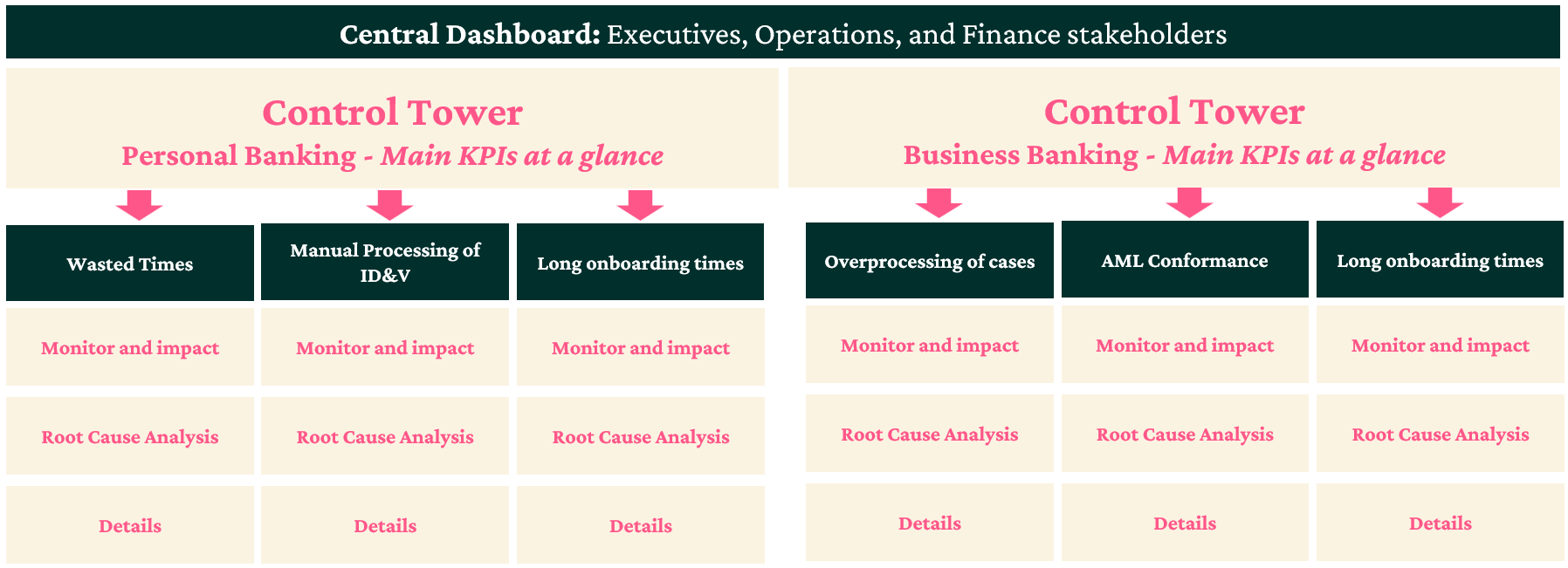
Control Tower Overview
The Control Tower surfaces the most common Client Onboarding pain points — such as wasted time, manual ID&V processing, long onboarding times, overprocessing of cases, and AML conformance gaps — and presents them in a clear, business-driven view. This gives onboarding leadership, operations, KYC, compliance, front office, and digital teams a holistic understanding of performance and trends over time, helping them quickly assess the situation and target action where it matters most.
Monitoring and Impact
From the monitoring and impact dashboards, onboarding leadership can quickly see both the business scope — number of applications, clients, documents, checks, alerts, and accounts — and the key performance KPIs such as onboarding cycle time, abandonment rate, duplicate application rate, straight-through onboarding rate, manual ID&V fallout rate, approval time, AML conformance rate, and activation delays. These KPIs help quantify the business impact of onboarding inefficiencies, including lost conversion, delayed time-to-revenue, increased manual workload, higher cost-to-onboard, and compliance exposure.
Root Cause Analysis
Following leadership’s direction, onboarding managers, KYC leads, compliance officers, and journey owners can identify why delays, rework, or conformance gaps occur. The Root Cause Analysis dashboard surfaces bottlenecks, deviations, duplicate cases, manual review triggers, document re-request loops, screening delays, unnecessary escalations, and hand-off delays between teams. Drilling down further, managers can isolate problem areas and instantly switch perspectives — analyzing impact by client segment, channel, product, risk profile, document type, ID&V outcome, screening result, team, or onboarding status.
Details
In the detailed operational view, onboarding specialists, KYC analysts, compliance users, and process analysts see a prioritized list of applications, clients, documents, checks, alerts, KYC cases, and accounts requiring attention. ARIS helps classify the root causes of delay or deviation, reducing the need for manual investigation. Combined with contextual data such as application status, document completeness, ID&V result, screening outcome, risk rating, approval status, account setup status, and activation progress, teams can immediately determine which cases require urgent intervention.
Use-case specific navigation beyond the Dashboards
All use cases follow the same structured approach, empowering managers, process analysts, compliance teams, KYC teams, and operational users to consistently identify inefficiencies, assess impact, and take action. In addition:
- Process Explorer – Enables exploration of actual end-to-end Client Onboarding flows based on event data.
- Process Model Overlay – Compares the reference Client Onboarding process with the process variants measured through object-centric process mining, highlighting deviations and compliance gaps.
- Process Overview – Allows users to analyze the full Client Onboarding process beyond a single use case.
All dashboards come with:
- Main KPIs
- Use-Case specific KPIs
- Object-level and case-level insights and Visualizations: Charts, Tables, Diagrams
- Multiple Filter: Dimensions, Categories
- Addressed Pain Points
- Potential Value Proposition
- Action Buttons
RELATED ARIS EDITIONS
- ARIS Process Mining Enterprise (SaaS and on-premise)
- Advanced Enterprise, Shared Enterprise
SUPPORTED ARIS USERS
Implementation / Technical Users
- ARIS Process Mining Engineers – install and configure the accelerator plug-and-play for a fast, ready-to-use solution.
- Project Management / Center of Excellence – coordinates the rollout, enabling a significantly shorter and faster-to-realize project plan.
Business Users
- Process Analysts – use the pre-built dashboards and root cause analyses to identify bottlenecks and drive improvements.
- Business Units / Order Fulfillment Teams – gain faster access to actionable insights on open, unshipped, unbilled orders and late deliveries.
CONTENT
This accelerator solution includes:
- Ready-to-use analyses
- Extractions that read comprehensive source tables from Client Onboarding - Banking
- Transformation logic to prepare and structure the extracted data
- A comprehensive set of calculations (KPIs and process measures)
- A data model describing the relationships between data entities
- Reference processes and mappings
RELEASE INFORMATION
- Supported UI language: EN
- Version: 1.0.0
- Publishing date: July 31st, 2026
- Author: SAG Aris GmbH
- Copyright: © 2026 SAG Aris GmbH. All rights reserved.
Installation, Prerequisites, Configuration, and Version History
-
Initial Installation
Follow this guide to install the accelerator via the ARIS Gallery or manual import, complete with demo data to explore right away. -
Prerequisites & Preparation
Required systems, access, and technical setup to go productive with your own SAP data.
-
Switch to Productive Data
Step-by-step guide to replace the demo data with your own SAP data. -
Request Accelerator for manual import
Request the accelerator file needed to perform a manual import, via the contact form. -
Version History
Track releases, updates, and changes over time.
Need Help?
If you have questions about any Accelerator or want to exchange experiences with others, visit our community forum. There you can ask questions, share insights, and support each other.