
Back to: ONE Standard - PCF® QuickStart
Overview
This section explains the fundamentals of the Process Classification Framework (PCF®) and how it is used within ARIS based on the ONE Standard. It provides clarity on what kind of information the PCF® delivers, what it does not include, and how it is translated into a structured and governed ARIS repository based on the ONE Standard methodology.
Table of Content
- What is the PCF®?
- What the PCF® Provides
- How the PCF® is Implemented in ARIS
- PCF® Structure Overview
- Alignment with ONE Standard
- PCF® Content Representation in ARIS – Examples
What is the PCF®?
The Process Classification Framework (PCF®), developed and maintained by APQC, is a globally recognized standard for structuring business processes.
It provides:
- A hierarchical process architecture
- Standardized process categories and groupings
- A common language for describing business processes
- Associated metric definitions for performance measurement
The PCF® is designed as a cross-industry framework and serves as a reference model for organizing and benchmarking business processes.
More information here: https://www.apqc.org/process-frameworks
What the PCF® Provides
The PCF® focuses on structure and classification, not on detailed process execution.
It includes:
- A standardized process taxonomy with hierarchical levels (e.g. categories, process groups, processes)
- Consistent naming conventions for processes
- A reference structure that can be adapted to specific organizations
- Metric definitions aligned with process areas
What the PCF® Does Not Provide
The PCF® is not a complete process model.
It does not include:
- Detailed, "complete" process flows (e.g. BPMN diagrams)
- System-specific implementations
- Organization-specific roles or responsibilities
- End-to-end process variants tailored to a company
How the PCF® is Implemented in ARIS
The PCF®-prepopulated project template database, which is provided via the ONE Standard – PCF® QuickStart or the ONE Standard – PCF® Industry Loader, is translated into a fully structured ARIS repository aligned with the ONE Standard Methodology
This includes:
- A predefined group structure reflecting the PCF® hierarchy
- Pre-created models representing the process architecture
- Standardized object definitions aligned with ONE Standard conventions
- Integrated metric definitions linked to process elements
PCF® Structure Overview
Before mapping the PCF® to the ONE Standard, it is important to first understand the overall structure of the PCF® and the type of information it provides. This is taken from the original PCF® content file (Excel) and represents the source of the structure, attributes, and screenshots shown below.
Process taxonomy with element naming:

Each process element ("line item") has his these attributes ("columns"):

Multiple Metric Definitions (with several attributes) are mapped to the process elements:

Alignment with ONE Standard
Mapping to ONE Standard Process Architecture
The PCF® represents a functional process structure and therefore aligns with the process landscape view in ARIS. It does not cover end-to-end business scenarios. The following table shows how the PCF® hierarchy levels are mapped to the ONE Standard process architecture.

Mapping of PCF® Attributes to ARIS
In addition to the structural mapping, the PCF® provides a set of attributes for each process element. These attributes are consistently transferred into ARIS and assigned to the corresponding objects and models.
- PCF ID
Stored as a dedicated attribute in ARIS and assigned to each process element across all hierarchy levels. Attribute name is: "External ID" (under "ARIS META DATA") - Hierarchy
Not stored as a separate attribute. The hierarchical structure is implicitly represented through the group structure and the leveling/assignment structure within ARIS repository. - Name
Used as the object and model name in ARIS. - Description
Maintained as a descriptive attribute on the corresponding object and model.
Compliance with ONE Standard Methodology
All mappings follow the ONE Standard methodology and conventions, which can be reviewed in detail on the corresponding documentation pages.
Mapping of Metric Definitions
The PCF® metric definitions are implemented as independent objects in ARIS. Each metric is represented as an object of type Metric / KPI.
These metric objects are technically assigned to the corresponding process elements and enriched with the following attributes:
- Metric Category
Transferred as an attribute with the same name in ARIS. - Formula
Transferred as an attribute with the same name in ARIS. - Unit
Transferred as an attribute with the same name in ARIS. - Metric ID
Stored as Attribute: "External ID" (under "ARIS META DATA")
PCF® Content Representation in ARIS – Examples
Level 1
- Model - The existing Level 1 Model will be enriched with PCF
- Objects - The highest PCF hierarchy elements will be occured as "Process Area" symbols (plus PCF attributes and mapped metrics)

Level 2
- Model - Assigend Level 2 model of superior Process Area
- Objects - List of related Process Group elements of PCF with attributes and mapped metrics.

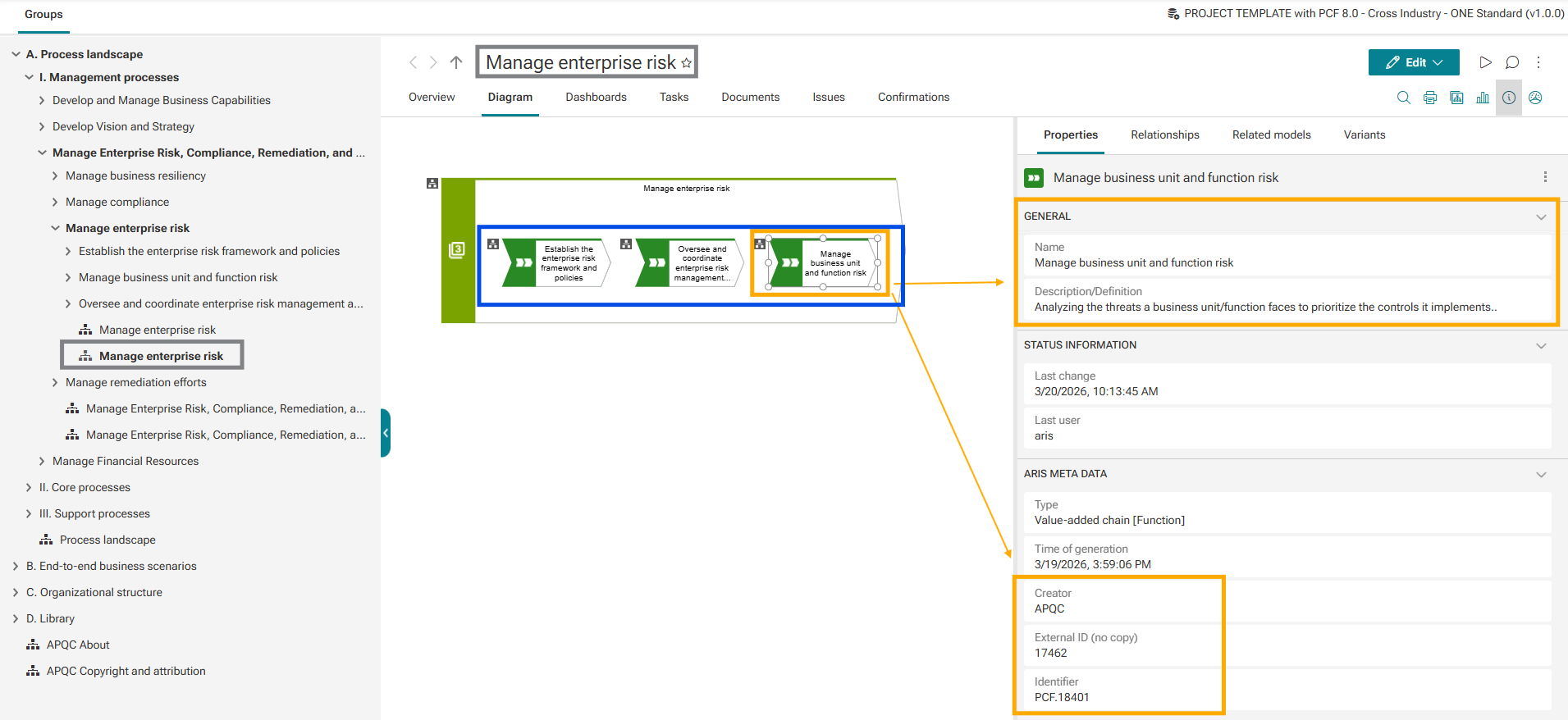
Level 3
- Model - Assigend Level 3 model of superior Process Group
- Objects - List of related Processes elements of PCF with attributes and mapped metrics. (Note: This example doesn't have mapped metrics)
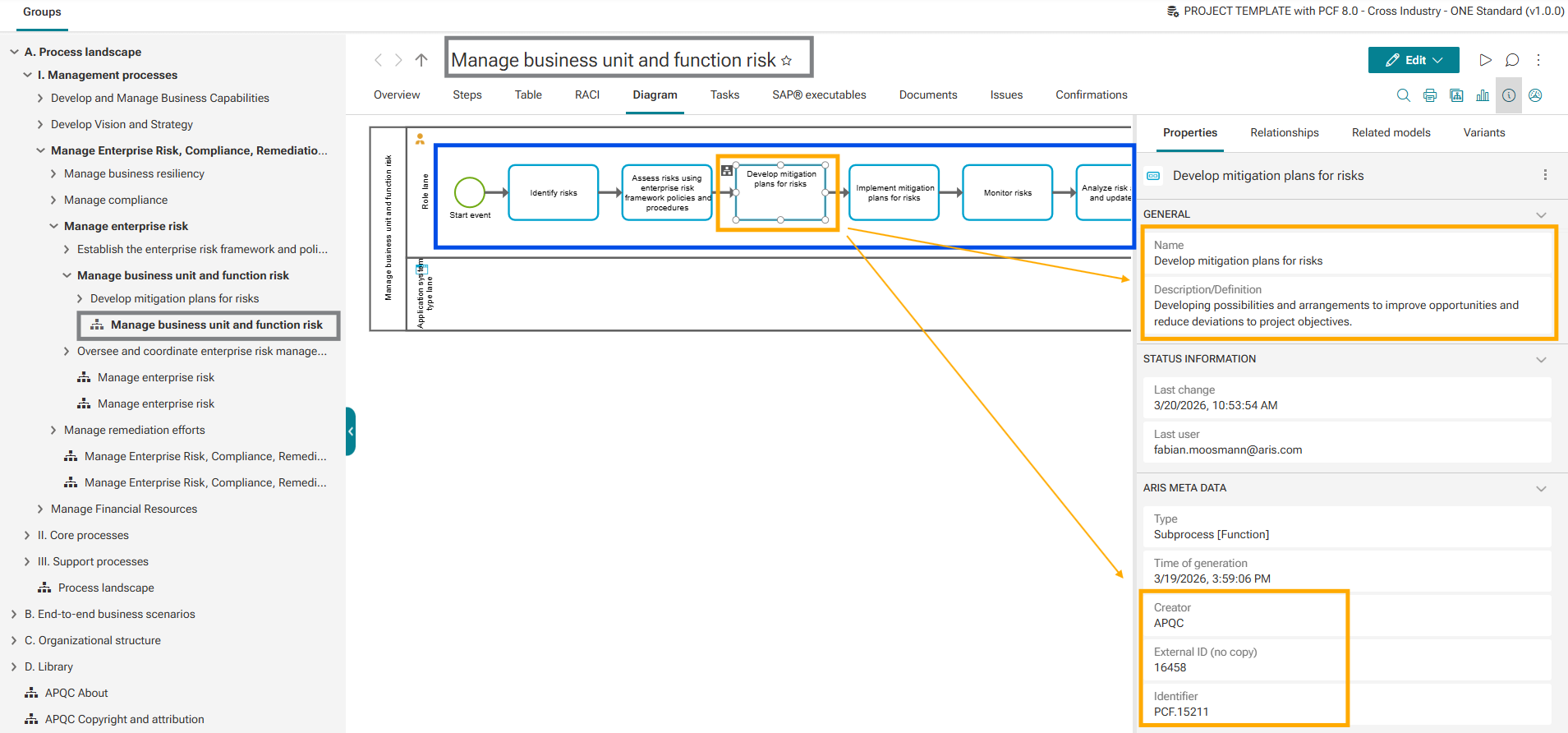
Level 4
- Model - Assigend BPMN model of superior Processes (object)
- Objects - List of related "Activities" elements of PCF with attributes and mapped metrics. (Note: This example doesn't have mapped metrics)
- Activities that have deeper nodes ("Tasks") are represented as Subprocesses (accoridng to BPMN specification)
- Activities that don't have deeper nodes as modeled as "BPMN Task" symbols (accoridng to BPMN specification)
- Note: PCF doesn't mention roles nor symbols. That's why these lanes are undefined.
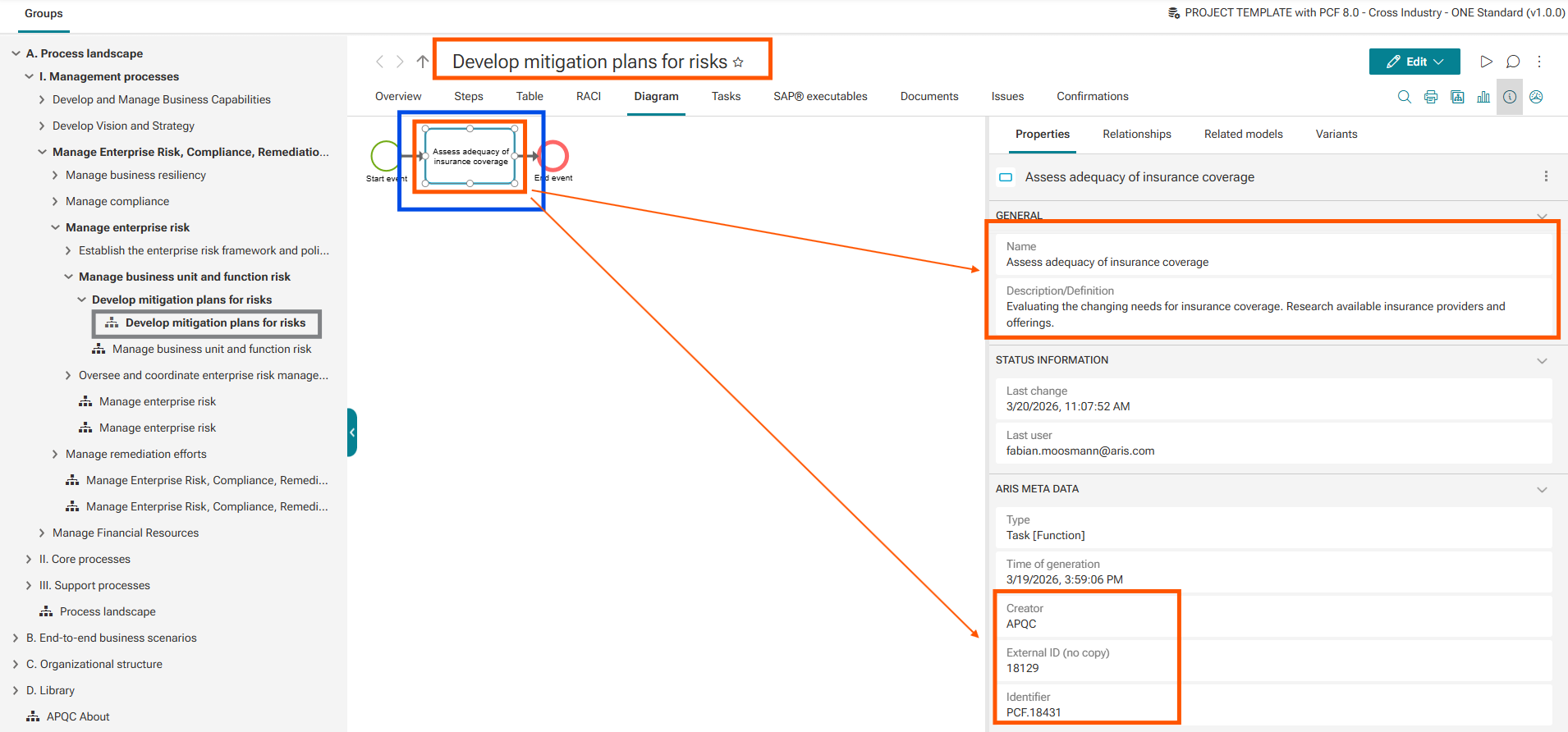
Level 5
- Model - Assigend BPMN Subprocess model of superior Activity (object)
- Objects - List of related "Task" elements of PCF with attributes and mapped metrics. (Note: This example doesn't have mapped metrics and only one Task element)
Metrics
- The Metric definitions are mapped to the PCF elements across all hierarchy nodes. You can see them in the related properties window as "Mapped Metrics" (see screenshot above)
- Additionally, we provide dedicated Metric library models (grouped by Process Category)
