
Every business runs on a ripple effect. A delayed raw material delivery causes insufficient inventory, forcing a production reschedule, which pushes back the customer's delivery date. In a traditional process mining view, each team — Sales, Manufacturing, Logistics, Procurement, Finance — sees only their slice of this chain. No one sees all the dominoes at once, before they fall.
ARIS Object-Centric Process Mining (OCPM) changes that. Now available in ARIS Process Mining (2026 April release), OCPM creates a unified, interconnected digital twin of your organization, mined directly from real event data across every system and function. The result is end-to-end process visibility, genuine cross-object bottleneck analysis, and a contextual foundation that powers the next generation of AI-driven automation.
What is Object-Centric Process Mining?
Object-Centric Process Mining is a new methodology that reimagines how we analyze and optimize business processes. Traditional process mining follows a single case — a purchase order, a sales order, a ticket — from start to finish in a linear sequence. It is a powerful technique, but one with a fundamental constraint: you must choose one object to follow, and you lose everything that happens around it.
This creates two structural data quality problems. Convergence occurs when one event is replicated across multiple cases, inflating counts and leading to unintentional duplication. Divergence occurs when multiple instances of the same activity appear within a single case, distorting the true process path. Both problems are artefacts of forcing a multi-dimensional reality into a one-dimensional log.
Here's what the difference looks like in practice. A flat event log says: "Invoice #4421 was approved." An object model says: "Invoice #4421 was approved — and it is linked to Purchase Order #8802, which is blocked by a delayed shipment from Supplier X, which is already affecting three other open orders." Same event; completely different operational picture.
OCPM replaces the flat event log with an interconnected object model, capturing multiple interrelated business objects simultaneously — orders, deliveries, invoices, materials, production runs, and more. You see how a Sales Order connects to a Delivery Item, which links to a Production Order, triggering a Purchase Requisition, and how all of these interact in real time, across every function and system. It helps business make better decision under real-world constrains.

From Flat Event Logs to an Interconnected Object Model
The architectural shift from flat event log to an object model delivers five concrete capabilities:
- Preserved data granularity: Analyze the actual impact on a Sales Order header independently from a line item or delivery — eliminating the need to duplicate or artificially aggregate data to fit a single case ID.
- True event sequencing: Parallel activities across object types become visible, enabling accurate throughput time calculations without imposing a false linear order.
- Flexible, non-case-bound analytics: Query and analyze contextual data tables independent of any case ID — for example, examining changes in master data and their downstream impact on process behavior.
- Genuine cross-object causality: when something goes wrong, you see not just where it broke — but also why, in full operational context.
- Holistic end-to-end visibility: one coherent view, not isolated process which allow you to simulate the ripple effect of a change before you act — how a procurement delay impacts manufacturing throughput.
What's New in the 2026 April Release
The latest release delivers three key capability improvements to ARIS Process Mining:
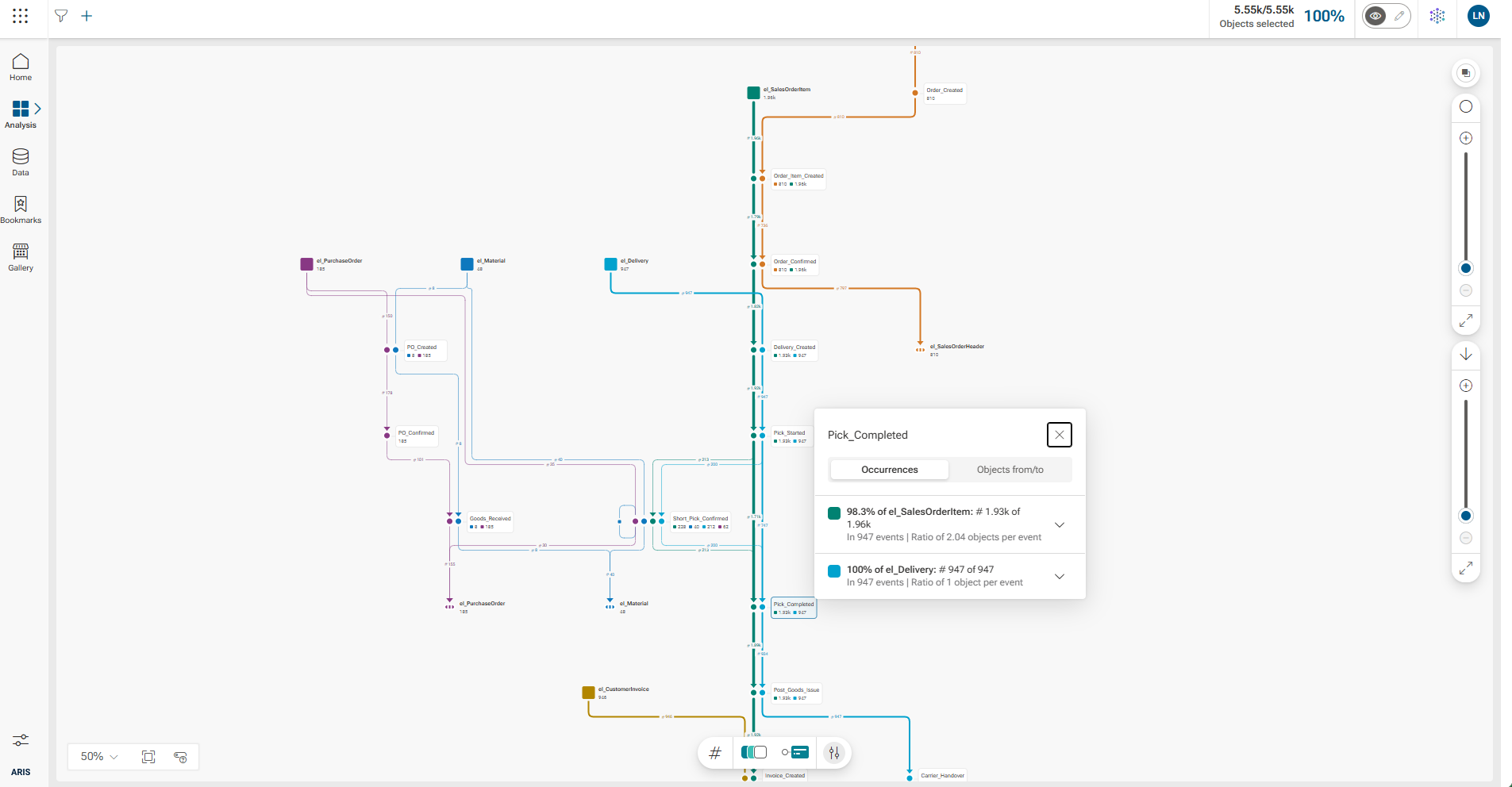
Object Centric Process Mining Process Explorer visualizes every business object type as a distinct, color-coded lane flowing simultaneously through your process. It replaces the isolated, per-function process view with a living, interconnected map of operational reality. When something goes wrong, you see not just where it broke — but why, in full context, in minutes rather than days.
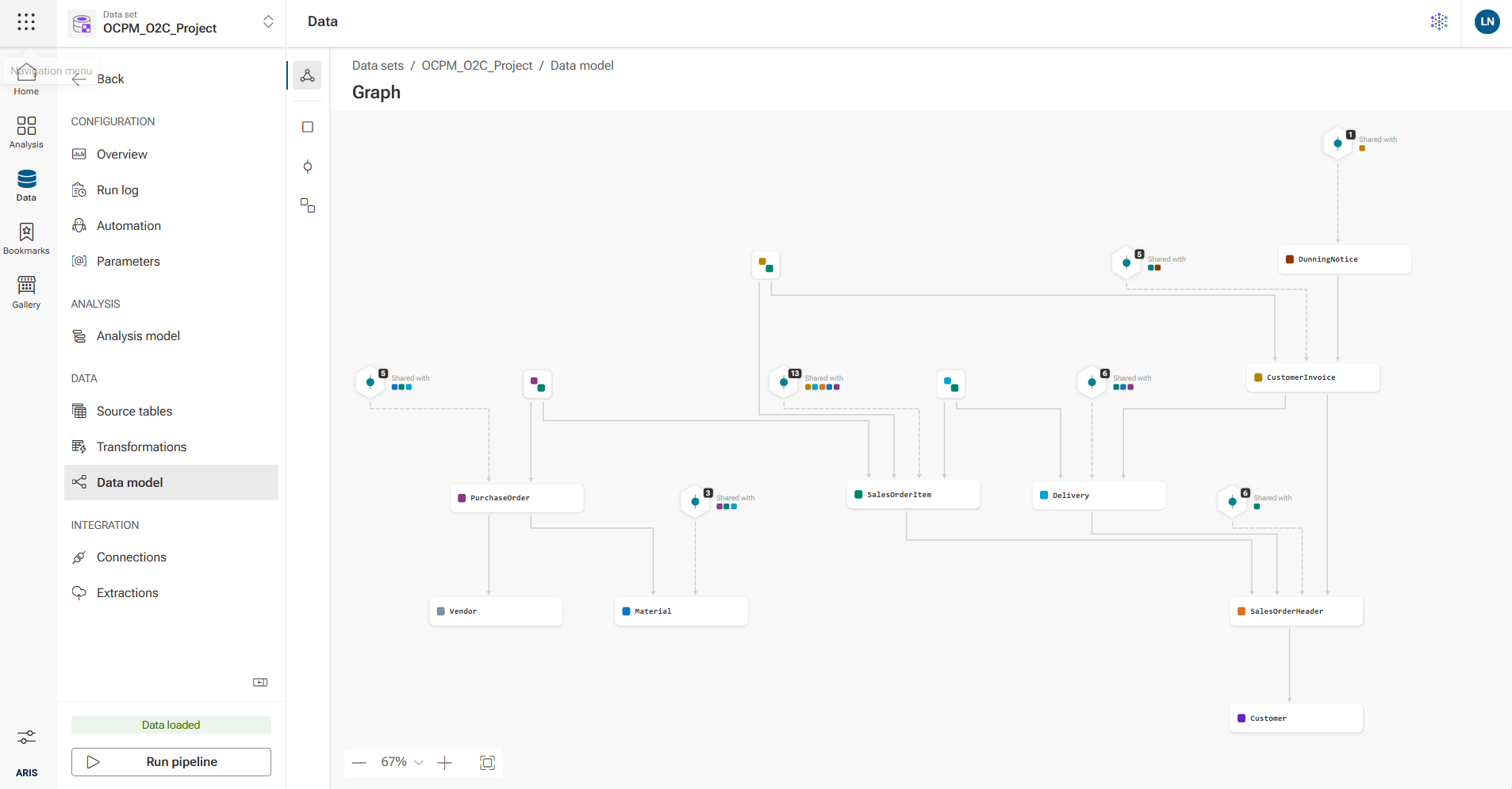
Object Relationship Graph models all business objects and their relationships in a single graph — without flattening or duplication. This is the foundation layer everything else builds on.
Improved performance with ad-hoc calculations reduces reliance on pre-computation, supporting both routine monitoring and exploratory deep dives with greater speed and flexibility. Combined with the new ARIS Query Language, analysts can perform BI-style, non-case-bound analysis directly on event logs and data tables — the flexibility that grounded in process intelligence.
A Foundation for AI and Operational Excellence
ARIS OCPM is not simply a feature release. It is a next-generation process intelligence platform for organizations serious about operational excellence, regulatory compliance, and responsible AI adoption.
In regulated industries, the governed multi-object process graph provides the auditability that compliance teams need. In high-volume operations — manufacturing, logistics, financial services, healthcare — it scales to analyze millions of events across dozens of object types without sacrificing analytical depth.
As organizations accelerate agentic AI, OCPM serves as the essential contextual layer between data and action. AI agents are only as good as the context they have. An AI agent grounded in an OCPM governed object graph understands the full operational context — the interdependencies, the ripple effects, the real-world constraints — and can therefore reason and act responsibly. Without that context, automation is fast but blind. With it, automation genuinely understands your business.
This is why OCPM matters beyond process analysis: it is the connective tissue that makes AI agents effective, trustworthy, and auditable.
ARIS Object-Centric Process Mining Foundation version is available now in ARIS Process Mining (2026 April release). Existing customers can explore OCPM capabilities in their current environment upon request
Book a live OCPM demo to see first-hand how object-centric analysis transforms process visibility in your environment and subscribe to the ARIS BPM Blog for upcoming deep dives into key OCPM features and practical how-to guides.