

Process knowledge is one of the most valuable assets an organization has and one of the most underused. It sits locked in documents, in the heads of experts, in diagrams on shared drives, and in ARIS repositories. The ARIS AI Companion exists to change that. It makes your process knowledge accessible, usable, and actionable for everyone, not just the process experts.
Over the past months we have made significant progress on two core capabilities: AI-powered model generation and the AI Companion chat in the ARIS Portal – available with 10.2026.4 for ARIS Enterprise SaaS.
Model Generation - Turning Documentation into Models
Every organization has a backlog of process knowledge that never quite makes it into ARIS. There are SOPs in SharePoint, process diagrams in PowerPoint, transcripts and images from a consultant engagement three years ago, Word documents capturing how things actually work. Everyone knows this content is valuable. Nobody has the time to manually model it.
The AI Companion's model generation capability tackles this directly. You describe a process or simply upload multiple documents that describe it and the AI Companion generates a structured BPMN or EPC model. File formats include for example PDF, Word, Excel, PowerPoint, Visio, and common image formats. Roles, IT systems, risks, and responsibilities are extracted from the input and attached to the process flow automatically. If the objects already exist in your repository, the Companion reuses them rather than creating duplicates. The result is a solid draft: something a process owner can review, refine, and publish in a fraction of the time it would have taken to model from scratch.
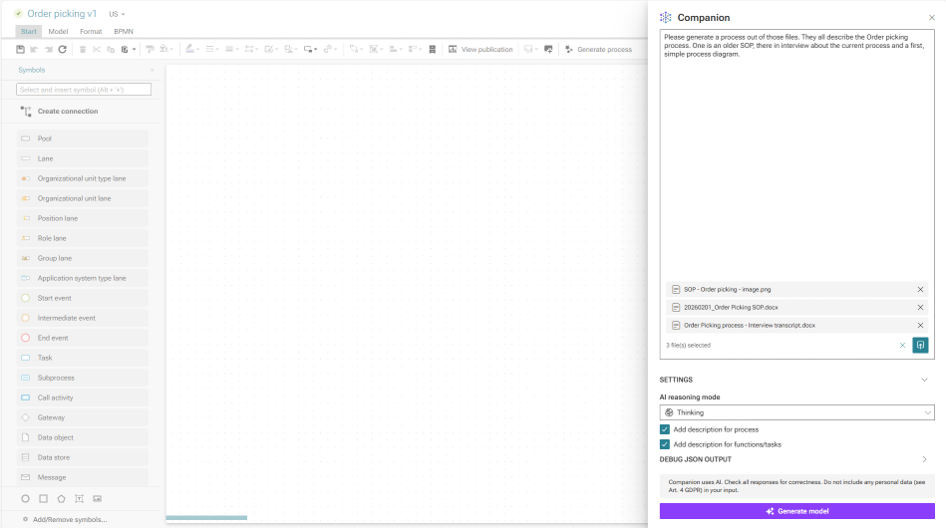
This matters most in a few scenarios that come up constantly. Organizations migrating process documentation into ARIS for the first time. Teams trying to keep pace with regulatory or operational change. Subject matter experts who understand a process deeply but are not process notation specialists. In all of these cases, the bottleneck is not knowledge it is the time and skill required to turn that knowledge into a structured model. The Companion removes that bottleneck.
Modeling and Improving as a Conversation
One of the most natural ways process models get created is in dialogue: an interview with a process owner, a workshop where the flow gets sketched out and refined, a back-and-forth between a designer and a subject matter expert. The Companion now works the same way.
After generating an initial draft, you can continue refining it through follow-up prompts in the same session. Add a step, reassign a responsibility, split a task into two, incorporate further requirements all by describing what you want in plain language.
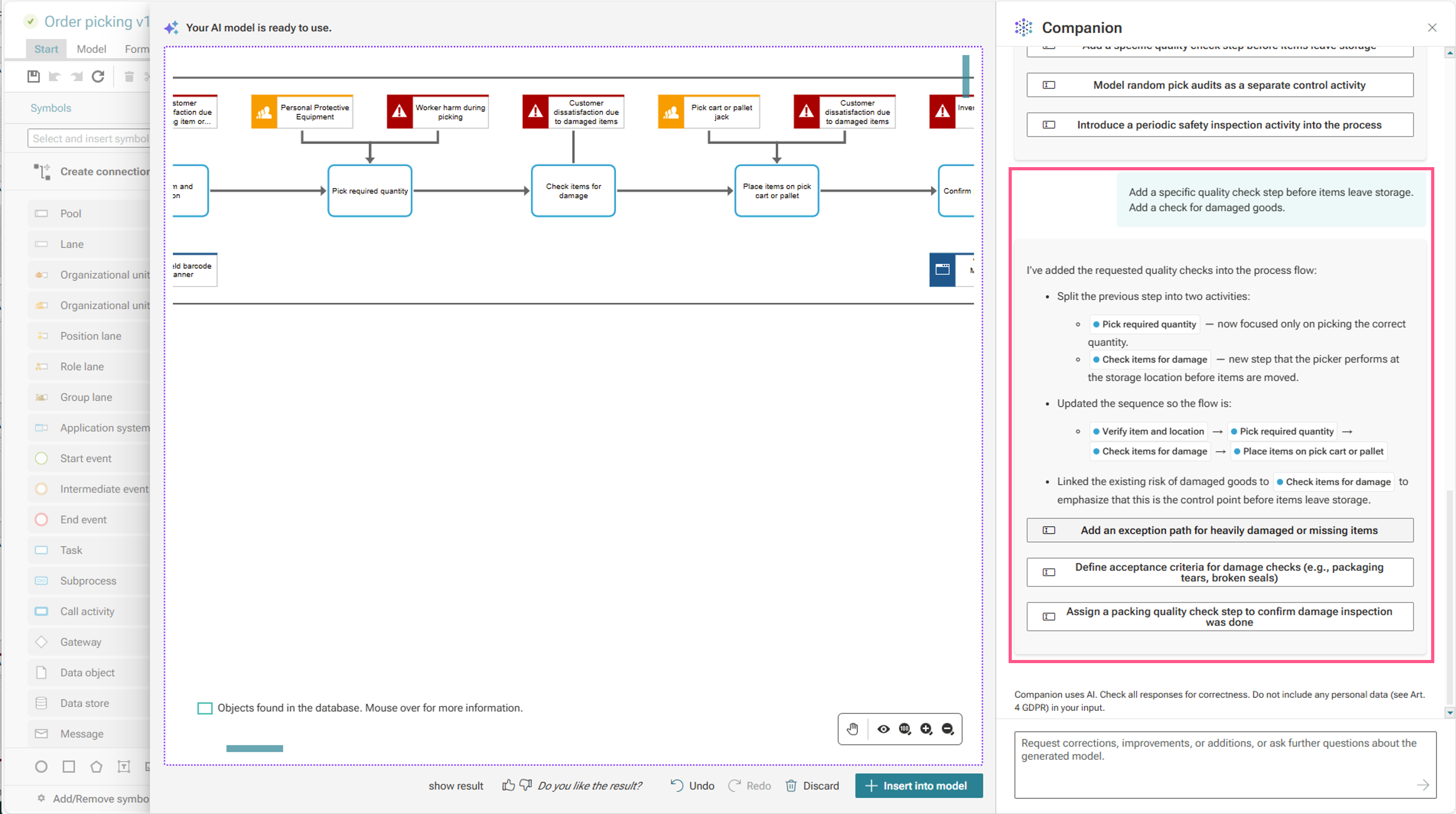
You do not need to know ARIS object types or notation rules. The Companion understands what you are asking for and updates the model accordingly, highlighting what changed so you can review it at a glance.
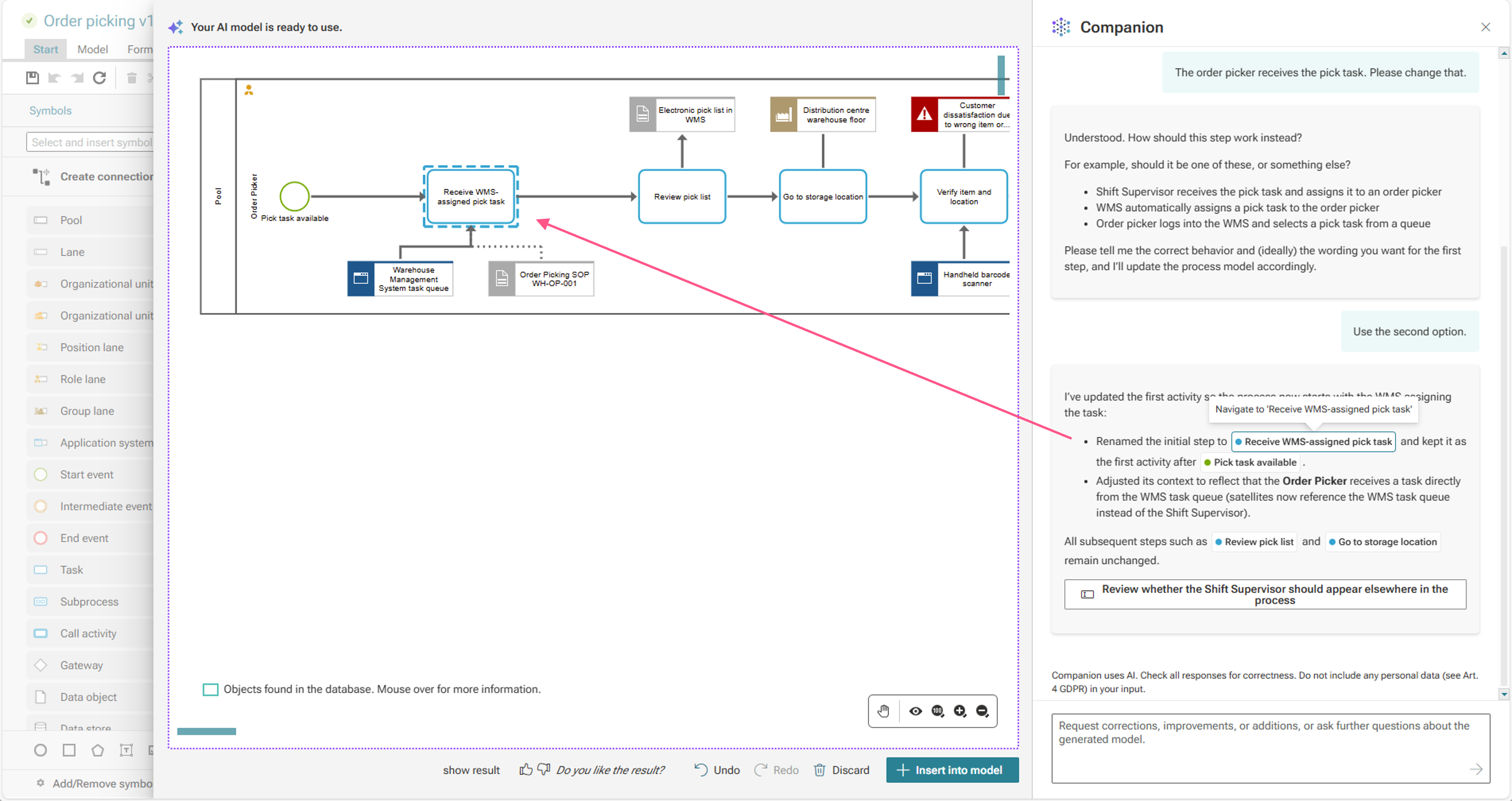
You can of course also ask the AI Companion to make general improvement suggestions for your model or analyse it for loops, incomplete information etc. If you're not satisfied with the changes made in the last step, you can simply use the undo feature to revert to the previous state and continue working from there.
A draft model is only useful if it fits into your existing architecture and follows your conventions. The AI Companion takes your organization's ARIS configuration into account during generation like custom methods, custom attributes, and method filters are respected.
Portal Chat - Making your ARIS knowledge available for everyone
Most of the people in your organization who could benefit from process knowledge hardly look at it. Not because the information is not there - it is - but because finding it requires knowing where to look and how it is called.
The Portal AI Companion focuses on the ARIS end-users, for example shop-floor workers process owners, new employees or business unit leads.
The Portal AI Companion offers you an alternative way of accessing your process knowledge. Instead of browsing and searching, you ask questions in plain language, the way you would ask a colleague. "What processes am I responsible for?" "Can you please give me an overview of the IT systems and their owners that are used in our order-to-cash process?" "What are the compliance risks in our procurement flow?" The Companion searches the repository, finds the relevant information, and gives you a direct answer, summarizing relevant points, aggregating information and presenting it in a structured way.
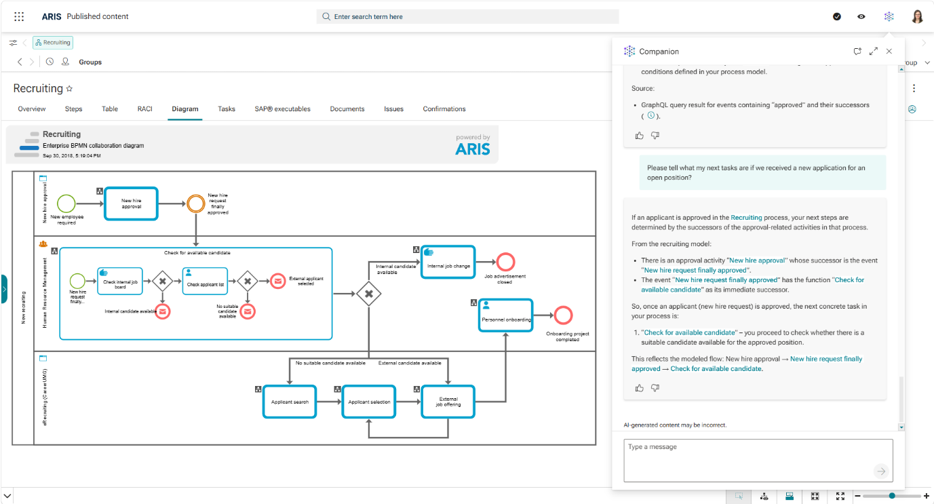
The Portal chat uses ARIS-internal agents that surface knowledge in a similar way a human user would, for example using the ARIS search in the background or query functionality. It can ask you follow-up questions build on what was already discussed, so you can drill into a topic progressively without having to re-state context each time.
Structured answers and sources
Answers are structured to match the question. A request for a list of processes comes back as a table or bullet point list with direct links to the processes or objects. A question about who is responsible for a process returns names, roles, and the relevant process, not a paragraph of text that buries the answer.
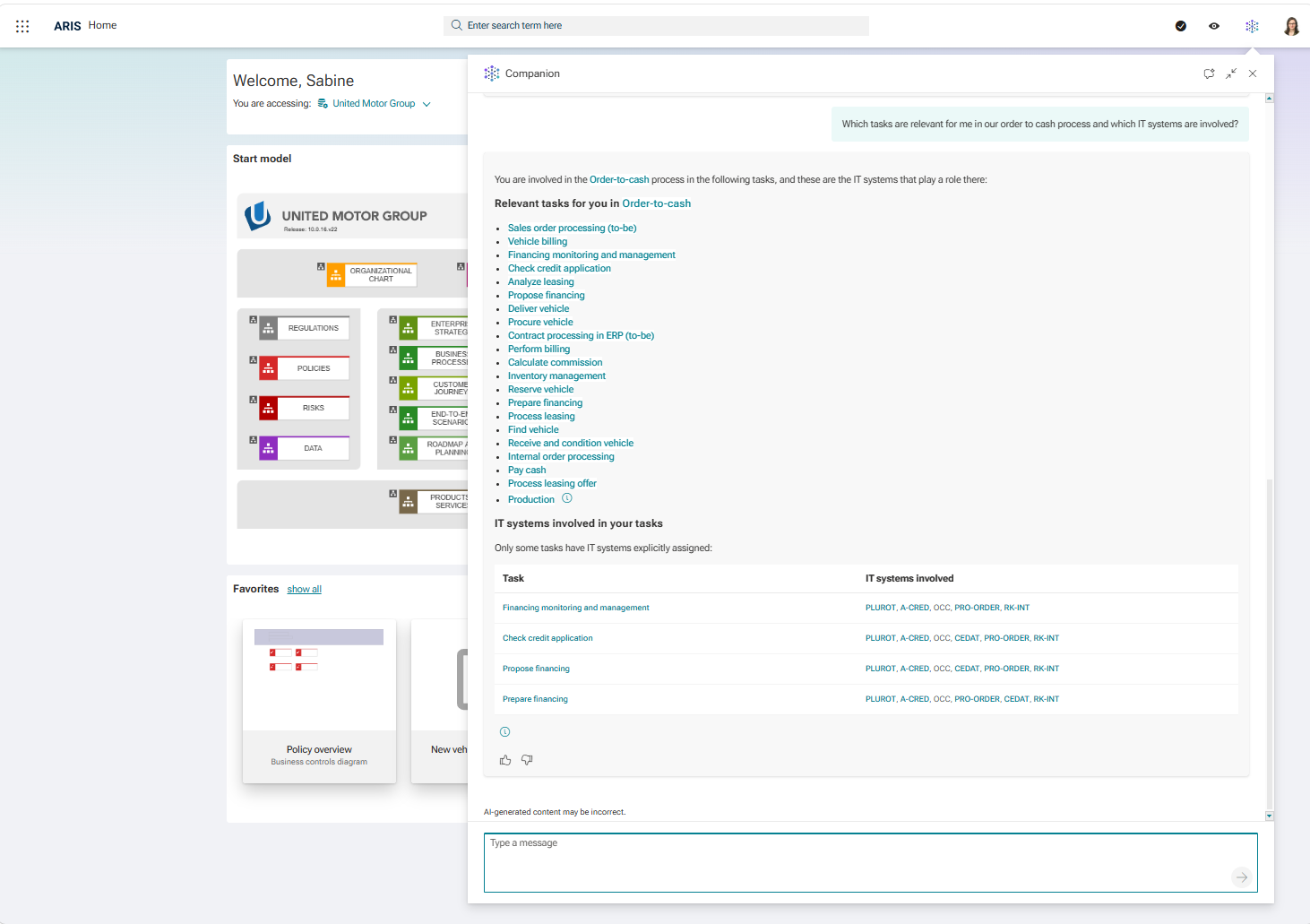
A recurring concern with AI tools is knowing whether to trust the answer. The Companion addresses this in a few ways. The Portal AI Companion currently only uses ARIS content for answer generation to prevent hallucinations. It always links its answers back to the source content, so you can verify what it found. When it is searching for an answer, it shows you the steps it is taking which makes it easy to understand why you got the result you did, and to ask a follow-up if something seems off. And when the Companion genuinely cannot find a reliable answer, it says so, rather than generating something plausible-sounding.
The AI Companion supports you in your everyday work
The ARIS AI Companion is built around a simple idea: the people who need process knowledge should easily have it at hand at any time without having to become BPM specialists. The ARIS AI Companion is already available and supports you in your Business Process Management and Process Mining tasks.
We would love to hear how you are using the Companion today and what would make it more useful for your organization. Share your thoughts in the ARIS Community.

Klemens Hauk on
Hello,
it`s still a pity, that Enterprise users only benefit from the AI enhancements. Even testing is not possible for the "poor" Advanced users. Is there any way to change this in future? Have a look on your competitors.
Regards
Klemens